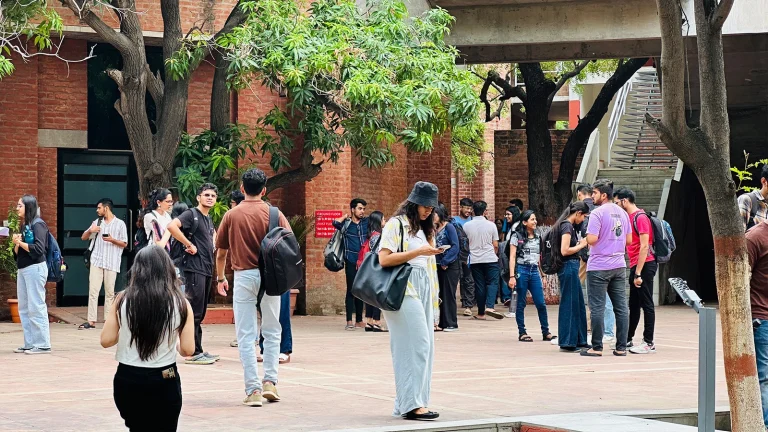
For students across MICA’s PGCM in Advertising and Marketing Communication, (Earlier CCC) programme, learning goes beyond academics. The curriculum is designed to help students see what sits behind the obvious: how brands are built, how ideas travel, how media shapes meaning, and how creativity can solve real problems.
Powerhouse of Ideas
Ideas are built by observing everyday life, understanding people, following culture, and noticing details that others might miss. Students learn to look at brands from their point of view: What makes a brand relevant? How does an insight become communication? Why can advertising sometimes feel despite being everywhere? They explore how brands are built on imagination, culture, and context, and how a strong idea can travel across different IMC formats.
This also means learning to go beyond the brand brief. A good communication programme teaches students not just to answer the question asked, but also the questions never asked. Students work with peers and industry mentors to develop solutions to real-world brand problem statements. Creativity is not a solo pursuit. It thrives on teamwork.
From content consumers to responsible creators
Content is produced constantly, and the balance between production and perspective keeps shifting. AI can recycle and remix existing content while content consumption continues to rise. The challenge, then, is not simply to create more. It is to create something worth noticing.
That requires knowing who you are before you decide what you want to say.
MICA encourages students to think of content creation as a responsibility, not just a skill. What churns your mind? What motivates you to create? What do you want your work to make people think, feel, or question?
Creativity meets AI
The rise of generative AI has made this more important. MICA’s approach to AI and emerging technologies focuses on balance: learning how to use new tools without allowing the tools to take over their own creative voice.
Students can learn to use AI as an efficient assistant rather than a final boss. Large language models can function like an inventory or buffet of words, useful for exploring possibilities, and accelerating parts of the process. But the final voice still needs to belong to the creator.
That means knowing when to use AI, when not to use it, and how to articulate a thought well enough to get useful output instead of generic AI slop. It also means balancing AI-enabled workflows with foundational manual skills and learning from industry professionals and mentors who understand how these tools are being used.
So, who is a typical MICAn?
It is someone who keeps their curiosity switched on. Someone who can move from a brand problem to a cultural observation, from an insight to an idea, from an idea to a campaign, and from a campaign to a larger question.
Someone whose curriculum does not just teach them what is already known, but trains them to see what could be.
At MICA, creativity is treated as a muscle: something to exercise, challenge and continually develop. The result is not one fixed “MICAn persona”, but a community of people learning to see differently and, eventually, helping others see differently too.
Related Learning Opportunities:
The School of Applied Creativity
MICA PGCM-Advertising And Marketing Communication (Earlier CCC)