MICA PGCM - Digital Media and Marketing Communications

MICA’s Post Graduate Certificate in Management (PGCM) in Digital Media and Marketing Communications is an AICTE-approved, one-year full-time residential (off campus) programme built for the creator economy – the platforms, audiences and business models that have reshaped how content, commerce and careers intersect. Designed around the philosophy of Create, Amplify, Monetise and Manage Content Across Platforms, it trains students to build sustainable creator-led businesses, not simply to produce content. Set on MICA’s 19-acre residential campus in Shela, Ahmedabad, PGCM-DMMC sits under MICA’s School of Applied Creativity.
One-Year full-time off campus Residential
48 Credits
Built for the Creator Economy
AICTE Approved
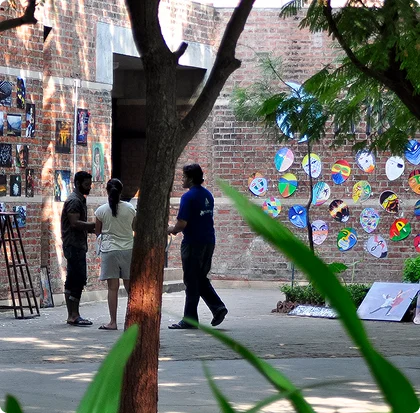
MICA students exploring communication, technology and society

On this page

What is MICA PGCM (Digital Media and Marketing Communication) - A Programme Built for the Creator Economy

MICA PGCM-DMMC (earlier known as CCE) is a one-year, full-time, compulsorily residential programme offered by MICA, Ahmedabad under the School of Applied Creativity, structured across four terms.
It is built for a career the formal education system has largely ignored: content creator, social media marketer, influencer, talent manager. Platforms like YouTube, Instagram and LinkedIn have built a multi-billion-dollar industry of individuals running sustainable businesses through content – and yet the skills that industry runs on have rarely been taught systematically. PGCM-DMMC exists to close that gap, taking students from audience psychology and content strategy through to platform economics, brand partnerships and the accounting behind a creator business.
MICA’s intent for its graduates is specific: to build sustainable creator brands using cultural cues and data-driven strategies; to leverage network dynamics and platform economics for content monetisation; to bridge brands and creators by building brand–content–influencer fit; and to be able to set up their own creator initiatives.
Graduates move into roles including Content Strategist, Social Media Marketer, Talent Manager, Platform Strategist, Brand Partnerships Lead and Creator Entrepreneur – at content studios, OTT platforms, digital agencies, creator-economy ventures and the content arms of consumer brands.
For advertising and brand creative craft – copywriting, art direction, integrated campaigns – MICA offers PGCM in Advertising and Marketing Communication (PGCM-AMC). For management-led brand and marketing careers, see PGDM-C and PGDM.

The PGCM (Digital Media and Marketing Communications) Year: Four Terms, One Arc

One Arc
 The year is built as a single progression – from understanding audiences, to making the work, to running it as a business.

How social media marketing actually works, and how digital content strategy is designed around audience psychology. Students build foundations in culture and context, consumer and audience psychology, the digital content economy and personal branding, go-to-market strategy, and the measurement and metrics that tell you whether any of it worked – alongside grounding in intellectual property, ethics and law.
The making term, and the largest in the programme. Students move into audio-visual production, storytelling and narrative dynamics, performance and voice, content planning and deployment, and engagement strategy – while learning the platform economics and monetisation logic that turn content into a business. Entrepreneurship basics sit alongside the craft.
The business layer. How the talent management industry works: brand partnerships, talent acquisition, brand deals, budgets and ROI, contracts and accounting, and the analytics that measure performance. This is where creator work becomes a commercial operation.
An immersion and industry internship placing students alongside content and social media professionals, culminating in a portfolio that captures the year’s work.

How MICA PGCM (Digital Media and Marketing Communication) Integrates GenAI, Platforms, and Creator Technology

PGCM-DMMC is built on the assumption that the creator economy is technology-shaped – and that creators who cannot work fluently with platforms, data and emerging media will be at a structural disadvantage. That thinking runs through the curriculum rather than sitting in a bolt-on module.
Platform economics and monetisation, engagement strategy, content planning and deployment, and audience psychology are taught as the substance of the programme, not as context around it. Students learn to read platforms as systems with their own economics and incentives.
Audio-visual production is the single largest course in the year, supported by studio labs with professional production equipment – so students are making work rather than waiting on outside resources.
Measurement and metrics in the opening term, and talent analytics and performance management later, build the habit of making creator decisions against data – the difference between a creator who grows by accident and one who grows by design.
Budgeting and ROI, accounting and contracts, and brand partnership fundamentals are taught explicitly, because sustaining a creator career depends on commercial literacy as much as creative range.

MICA PGCM (Digital Media and Marketing Communication) Eligibility and Admission Process 2027

PGCM-DMMC is built for candidates who already have a creator instinct – expressed through existing content, business ideas, creative work, or simply a demonstrated understanding of the industry – and want to formalise it into a career.
A bachelor’s degree in any discipline from an AIU-recognised university. The programme welcomes candidates from communication, design, fine arts, journalism, business, technology and humanities backgrounds.
Digital natives serious about content creation; aspiring creators seeking business frameworks; marketing professionals moving into creator-economy roles; entrepreneurs planning content ventures; and creative professionals looking to monetise their work systematically.
Entrance test requirements, application deadlines, and selection rounds to be received from the admissions team.
the programme is compulsorily residential. Students live on campus throughout the year, except during declared term-end breaks, internships and immersions – commuting from off-campus is not permitted, even for those living nearby.
For complete details and to apply, see the MICA PGCM-DMMC admissions page.

Eligibility Criteria

  • Admission to the Post Graduate Certificate in Management (Digital media and Marketing Communications) PGCM (DMMC), (Earlier Content Creator Economy (CCE)) require a Bachelor’s degree (10 + 2 + 3 system) or an equivalent qualification in any discipline recognised by the Association of Indian Universities (AIU).
  • Bachelor’s degree with at least 50% marks or equivalent CGPA in any discipline from a recognised university.
  • Candidates appearing for the final year bachelor’s degree/equivalent qualification examination and those who have completed the degree requirements and are awaiting results can also apply. It is mandatory for such candidates to complete the following:
  • Produce a certificate from the principal/director/registrar/head of the department of the institution/university certifying that the candidate is currently in the final year/is awaiting final results, stating that they have completed all the requirements (the result may, however, be awaited) for obtaining the bachelor’s degree/equivalent qualification on the date of issue of the certificate. This certificate should be submitted latest by June 30, 2027,
  • Such a candidate, if selected, and submits the above-mentioned certificate will be allowed to join the programme provisionally. The admission will be confirmed only when the candidate submits the final mark sheet and certificate of having passed the bachelor’s degree/equivalent qualification.
The deadline for submission of the final mark sheet and passing certificate is December 31, 2027. Non-fulfilment of this condition will automatically result in the cancellation of the provisional admission.

Admissions and Selection Process

The admission process comprises Online Application, MICAT and Personal Interview (PI). MICAT is conducted twice a year, in December 2026 and February 2027, and candidates may appear for both, with the better score considered. Shortlisted candidates are invited for the Personal Interview. Final selection is based on the candidate’s performance in MICAT and PI.

MICA PGCM (Digital Media and Marketing Communication) Fees and Scholarships

The fees for the one-year programme in 2026–27 was INR 13.3 lakh, inclusive of tuition, residential charges, internet and computing, library and database access, and medical facilities and insurance. Fees are payable in two installments across the year.
Scholarships. MICA awards scholarships annually on a merit-cum-means basis, and PGCM-DMMC students are eligible. Awards range from 25% to 100% of tuition fees, with family income the principal criterion alongside academic and other achievement. Shortlisted applicants are interviewed by the MICA Scholarships Committee.

Where MICA PGCM (Digital Media and Marketing Communication) Graduates Go: Career Outcomes

PGCM-DMMC prepares graduates for the full spectrum of roles in the creator and content economy.
Content Creator, Social Media Marketer, Influencer, Content Strategist – the four destinations MICA names directly for the programme. Strategy and management roles: Talent Manager, Platform Strategist, Brand Partnerships Lead, Audience Growth Lead.
Creator Entrepreneur, founder of a content studio or creator-led venture, or an independent creator with a built personal brand and a working monetization strategy – an outcome the programme is explicitly designed to enable.
a full year of creative craft, platform strategy and creator economics in one intensive programme; production facilities that let students make work rather than plan it; an industry immersion and portfolio built into the year; and entry into a MICAn network more than 5,000 strong worldwide.

MICA PGCM (Digital Media and Marketing Communication) in Context

Most Indian programmes offer either Media and mass communication degrees that cover journalism and traditional media, but rarely the creator business model. Pure design programmes build visual craft, but don’t address platform strategy or monetisation. General management MBAs build business thinking, but don’t develop creator craft.

PGCM-DMMC is built such that creative production, platform fluency, business strategy and entrepreneurship sit inside one curriculum, and where a student is expected to leave with both a portfolio and a business model.
Within MICA, the choice is reasonably clean. PGCM-AMC suits those focused on advertising and brand creative craft – copywriting, art direction, integrated campaigns – rather than the platform-and-monetisation side. PGDM-C suits those who want a management-led brand and communications career rather than a creator-led one.

Learn From the Best

Prof. Name

Program Chair

Prof. Name

Role

Prof. Name

Role

Prof. Name

Role
Plus: Visiting faculty from leading agencies and production houses, bringing current industry practices directly to your classroom.

Life at MICA – Off campus Residential Campus, Cohort, and Learning Culture
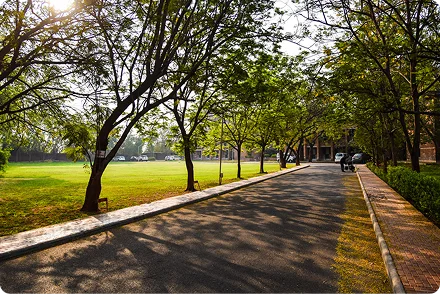
MICA sits on a 19-acre fully residential campus in Shela, Ahmedabad, where classes for PGCM (Digital Media and Marketing Communication) students are conducted. The students get a supportive and reflective environment on campus, this matters because building creator work is iterative and creative process. The PGCM (Digital Media and Marketing Communication) cohort is intentionally diverse, drawing students from communication, design, fine arts, technology, business, and humanities backgrounds. The studio labs with professional production equipment mean students aren’t waiting for outside resources to make work, and the small batch size enables individual mentorship from faculty and visiting industry leaders. Industry mentorship from figures including Shekhar Kapur and Suraja Kishore adds a layer of professional guidance that few other programmes can offer.
Campus life is anchored by signature events that are MICA-specific: Micanvas, the institute’s annual cultural and creative festival, and Mic-Drop, alongside the Creator Pitch Showcase, studio reviews, guest workshops, and the wider MICAn community that connects PGCM (Digital Media and Marketing Communication) students with creative professionals across the alumni network.

What MICA'S Graduates Do Now

Maheshwari Rawat image
MICA’s curriculum directly translated to my success in securing a summer placement and a PPO at Google. What truly sets MICA apart is its community. The unwavering support from faculty, PlaceComm, and my peers was incredible, and experiencing the strength of the MICA network firsthand through the mentorship of MICA seniors already at Google was an invaluable part of my journey.

Maheshwari Rawat

Product Support Consultant, Google India

Aditya Singh image
Securing a PPO from HSBC has been a defining milestone in my professional journey, and I owe much of this success to the rigorous ecosystem at MICA. The college’s focus on strategic marketing and consumer insights provided me with the unique toolkit needed to excel during my internship.

Aditya Singh

Management Trainee, International Wealth and Premier Banking - HSBC

Frequently Asked Questions About MICA PGCM
(Digital Media and Marketing Communication)

What is MICA PGCM (Digital Media and Marketing Communication)?

A one-year, full-time residential (off-campus) Post Graduate Certificate in Management in Digital Media and Marketing Communications, offered by MICA, Ahmedabad under the School of Applied Creativity. It totals 48 credits across four terms, covering social media marketing, content creation, talent management, platform economics and creator entrepreneurship.
Create, Amplify, Monetise and Manage Content Across Platforms – covering not just content creation but the full creator business: building audiences, understanding platform economics, generating revenue, and sustaining a creator-led venture over time.
It is a one year, spread across four terms. Term One covers social media marketing and audience psychology; Term Two, content creation and production craft; Term Three, talent management and the commercial side – brand deals, budgets, contracts and ROI; Term Four, an industry immersion and internship, closing with a portfolio.
Yes. PGCM in Digital Media and Marketing Communications was earlier known as CCE.
Yes
Content creator, social media marketer, influencer and talent manager are the destinations MICA names directly, alongside content strategy, platform strategy and brand partnership roles at content studios, OTT platforms, digital agencies and creator-economy ventures. A number of graduates build their own creator-led ventures.
Both are one-year residential programmes under the School of Applied Creativity, addressing different parts of the creative industry. PGCM-AMC focuses on advertising and brand creative craft – copywriting, art direction, integrated campaigns. PGCM-DMMC focuses on the creator economy – social media marketing, content creation, talent management, and content monetisation.
The Creator Pitch Showcase is a capstone exercise in the final year, where students pitch original content and business concepts to a jury of faculty, alumni, and industry stakeholders. Selected pitches may be profiled in institutional reports, shared with potential collaborators, or developed further through MICA’s incubation pathways.
Digital natives with creative ambition and a business orientation – aspiring creators wanting formal training, marketing professionals moving into creator-economy roles, entrepreneurs planning content ventures, and creative professionals looking to monetise their work systematically.
The fees of the one-year programme in 2026-27 was INR 13.3 lakh, inclusive of tuition, residential charges, internet and computing, library and database access, and medical facilities and Insurance.
PGCM-DMMC students are eligible for MICA’s merit-cum-means scholarships, ranging from 25% to 100% of tuition fees*, with family income as the principal criterion.

PGCM – DMMC is a residential programme but the accommodation provided is off campus.

Yes. Candidates need to appear for MICAT to be eligible to secure admissions for PGCM-DMMC MICAT is MICA’s own entrance exam, conducted twice a year – (typically in December and February). The better score from two MICAT attempts is considered.
No, in order to secure admission to PGCM-DMMC programme CAT/XAT/GMAT score is not required.
Yes. This is an AICTE-approved, one-year certification programme.

Related content

Consectetur adipiscing elit, sed do eiusmod tempor incididunt ut labore et dolore magna aliqua.