
At MICA, curiosity isn’t something you leave at the door. If anything, it’s where the learning begins. Because being a MICAn is less about being chosen and more about how you choose to see the world — with an urge to make something of what you observe.
The School of Applied Creativity (SoAC) takes that curiosity and puts it to work. It brings together two different programmes, PGCM in Advertising and Marketing Communication (PGCM-AMC) and PGCM in Digital Media and Marketing Communication (PGCM-DMMC). Each offers a different entry point into the creative industry. What connects them is the belief that creativity is not just about having ideas. It is about understanding where they come from, who they are for and what you can make of them.
For an AMC student, that could mean getting a ringside view of advertising and marketing communication — understanding how brands think, how consumers behave and where the core thought behind a campaign comes from. You learn to look at something as simple as a product, a behaviour or a brand truth and ask: what else could this become? How can a familiar idea be placed in an unfamiliar context? How do you turn one simple observation into a thought strong enough to become a campaign? And perhaps most importantly, how do you create advertisements people willingly consume? Copywriting, art direction, strategy and integrated campaigns become ways of answering these questions, with craft and strategic thinking developed in parallel.
For a DMMC student, the questions shift towards the world of digital platforms, creators and personal brands. What makes someone worth following? How do you build a personal brand that feels distinctive without seeming manufactured? How does a social media strategy move beyond simply posting regularly? And how do culture, communities and changing digital behaviours influence what people choose to watch, share and engage with? The programme explores content strategy, social media, cultural understanding, platform dynamics, brand partnerships and the business of building sustainable creator identities. It looks at creators not simply as people who make content, but as brands, businesses and cultural participants in their own right.
Across both programmes, the classroom becomes a space where ideas are constantly pulled apart and put back together. A brief is rarely just a brief. A cultural observation can become an insight; an insight can become a thought; and a thought can eventually become something people engage with or remember. Discussions, workshops, projects and conversations with practitioners bring students closer to the realities of industries where the brief rarely comes with all the answers.
A lot of this learning also happens outside the classroom. Field visits, cultural research, projects and exhibitions encourage students to pay attention to what is happening around them. A street, a conversation, a strange little habit or an overlooked detail can become creative material. The process is often simple: observe, question, interpret and make. What changes is the way you begin to see things.
The SoAC experience extends into the people you learn with, too. Student-led communities and committees give students room to explore interests beyond their programmes. ShutterBugs creates a space for photography and visual expression, while MICA’s Film Club brings together students interested in films, filmmaking and visual storytelling. These spaces make learning less solitary. You see how someone else approaches an idea, bring a perspective, deliberate and sometimes discover something you would never have arrived at alone.
And because the creative industry is constantly changing, the work cannot exist separately from technology. AI, digital platforms and emerging media are reshaping how ideas are created, distributed and experienced. At SoAC, the focus is not simply on learning another tool, but on understanding what the tool makes possible — and developing the judgement to know when it is actually worth using.
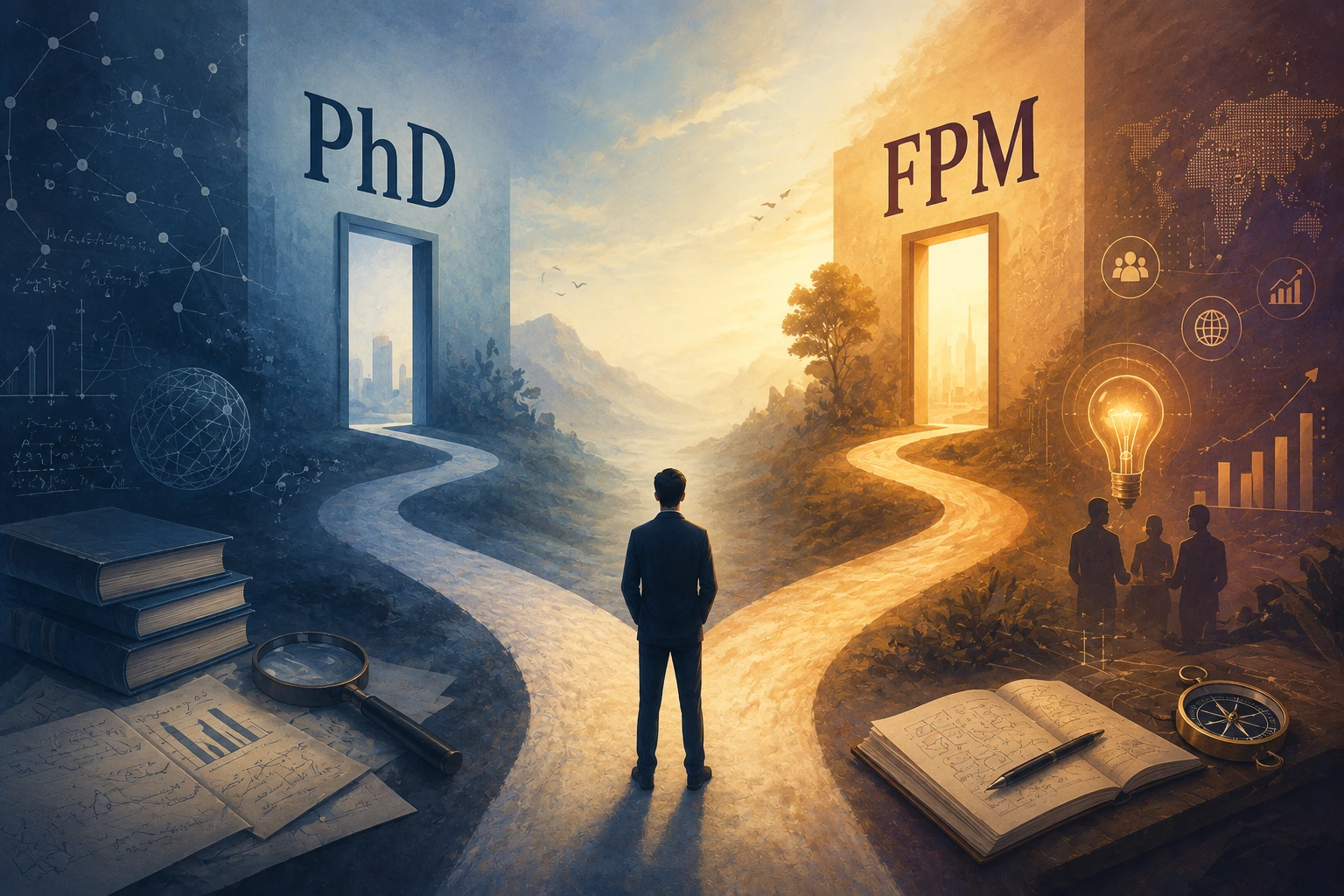
Most FPM programmes mandate a master’s degree (or an integrated master’s programme over four or five years) with a minimum aggregate mark of 55%, or a professional qualification such as CA, CS, or ICWA. A valid score in the institution specific entrance exam is required, although candidates who hold an MBA or PGDM from a leading institute may be granted a waiver. While prior work experience is not obligatory it is generally seen as a positive factor, and increasingly professionals with 10 or more years of experience are entering FPM programmes with the aim of moving into academic or research positions later in their careers.
Then there is the part that cannot really be written into a curriculum: being a MICAn. It is the people around you, the conversations that run longer than expected, the sudden ideas that appear in the middle of an ordinary day and the constant exposure to people who see the same world differently. There is no single way to be a MICAn. You might be a copywriter, an art director, a creator, a strategist, a filmmaker or something that does not have a job title yet.
What connects the experience is the willingness to look twice. To question the obvious. To find the thought hiding inside the ordinary and then figure out what to do with it. Because perhaps you don’t become a MICAn when you arrive at MICA. You become one every time you look at something familiar and think, “There has to be another way of seeing this.”