How Can Creativity X Management Create Magic?

Businesses today are looking for talent who are adept in the interdisciplinary mix of creativity and management
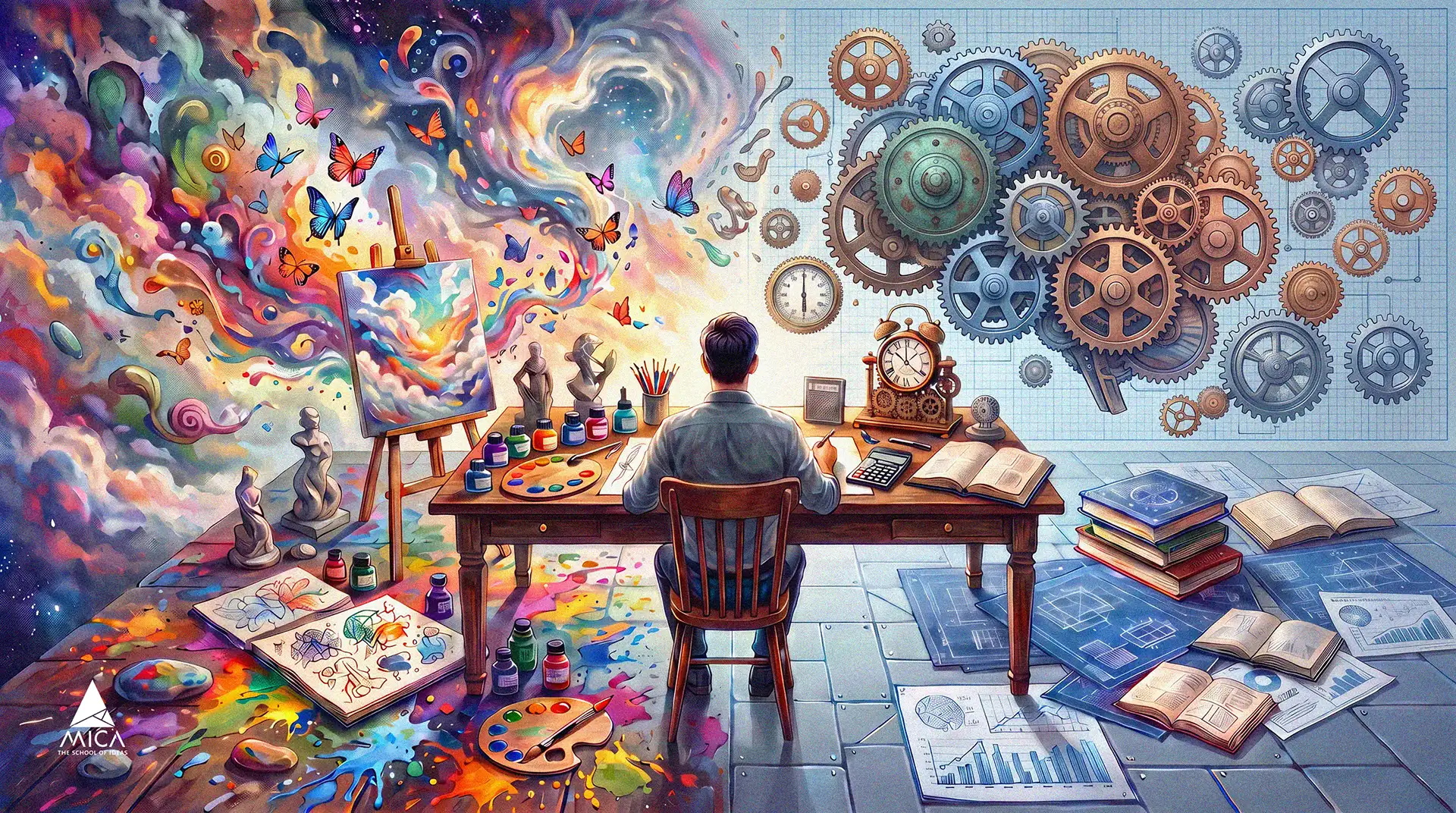
Conceptual illustration of creative and analytical thinking coming together to support strategic decision-making, innovation, and business leadership.

Admissions Committee

Today’s businesses are always searching for something unique, an edge that process and planning alone rarely deliver. With AI and new technologies on the rise, automation makes it clearer that we need qualities machines can’t easily copy: judgment, the ability to sense what will move people before the data confirms it. That’s where creativity comes in. And increasingly, it’s not being asked to sit in a different department from management, but collaborate with it, in the same person, on the same problem.

Two disciplines, one instinct

People often see creativity as management’s quirky sibling, useful for the mood board, irrelevant to the spreadsheet. But look closely, and the two share far more than they’re given credit for. Every creative process- brainstorming a campaign, updating a product, redesigning a store layout, follows the same underlying arc: defining the problem, generating options, weighing them against constraints, and choosing a solution. Management runs on exactly these steps, just under a different name.

Look at it broadly, and management is really the art of creatively solving problems with existing resources. Whether it’s allocating a tight budget across competing priorities, rethinking a store’s architecture to change how customers move through it, or designing a smoother user experience within a fixed engineering timeline, each of these tasks demands the same imaginative thinking usually reserved for art. The manager who finds an elegant workaround to a resource constraint is doing something structurally identical to the designer who finds an elegant solution to a design constraint; the discipline just wears a different uniform.

The shared psychology

Both domains run on the interaction between divergent and convergent thinking. Divergent thinking is the capacity to generate multiple possibilities, the wide net, the “what if” phase. Convergent thinking sifts and sharpens those possibilities into something practical and deliverable. Neither works in isolation. Divergent thinking without convergence creates noise, a hundred ideas and no way to choose between them. Convergent thinking without a divergent starting point simply narrows down what already exists, refining the obvious answer rather than discovering a better one.
This is precisely why organizations that silo “the creatives” away from “the managers” often get stuck at one extreme or the other: brilliant ideas that never survive contact with a budget, or budgets that are perfectly managed toward an uninspired outcome. The magic as it is lives in the handoff between the two, and increasingly, businesses want that handoff to happen inside one mind rather than across a conference table.

Frameworks already proving it

Businesses today are already practicing fusion through established frameworks. Design thinking is the clearest example. Now a management essential for idea generation, it’s built on managerial rigor across five disciplined stages: understanding, defining, ideating, prototyping, and evaluating. Each stage is structured, yet imaginative; each demands both the freedom to explore and the discipline to converge on schedule.
Brand-building works the same way. Strategy and creativity are inseparable here: a brand strategy without a creative core is invisible, technically sound but unmemorable, while a creative core without strategic discipline is abstract, all mood and no outcome. The brands that endure are the ones where a strategist and a creative aren’t just collaborating, but thinking in the same register.

Why this matters for talent

The implication for hiring and education is significant. Contrary to the popular belief that creativity is innate, something you either have or don’t, studies increasingly show it is a trainable skill, one that can be structured, practiced, and measured alongside conventional management tools like ROI analysis, stakeholder mapping, and process design. That reframing matters enormously for how talent is developed. It means creativity doesn’t have to be quarantined in a separate department or hired in as an external vendor; it can be built into a manager’s own skillset, the same way negotiation or financial literacy is.
This is also where the future of work is visibly heading. As AI absorbs more routine analytical work, the parts of management that were always closer to pure computation, what remains distinctly valuable is the part that requires framing a genuinely new problem, sensing a cultural shift before it’s obvious, or telling a story no algorithm would think to tell. The professionals who thrive won’t be the ones who chose a side of the brain early and stayed there. They’ll be the ones fluent in both, comfortable narrowing a hundred ideas into one deliverable plan, and equally comfortable generating that hundred in the first place.
This rethinking is what makes the “magic” directed and outcome-driven, rather than a happy accident that only some people are lucky enough to produce.

Curious why this integration matters? At MICA, creativity isn’t treated as an isolated artistic capability but as a strategic business skill integrated with marketing, consumer behaviour, communication, analytics, and innovation. Through interdisciplinary learning, live industry projects, and design-led problem solving, students develop the ability to think creatively while making sound business decisions a capability increasingly valued across consulting, marketing, brand management, digital businesses, entrepreneurship, and beyond.

Explore MICA’s programmes at the intersection of creativity and management to discover how this unique blend prepares future-ready leaders.

Share

AUTHOR

Mica admission committee

You might also like