
Her ideas presented in 2010 seem to become a reality that we are experiencing as technology democratises access to information the next big strategic move would be to make sense of this information and turn it into something valuable. For which, the foundational skill is imagination and therefore, she called it the ‘Age of Imagination’.
Just like, in the Information Age knowledge and data were the primary sources of economic value, similarly in the present times when artificial intelligence is doing much of the cognitive heavy lifting it is imagination the is the reliable currency. Imagination is the single irreplaceable human faculty. As Rita, J. King, put it, “In the Imagination Age, we can collectively imagine and create the future we want to inhabit before we lose that chance.” In the current times, imagination is not fantasising or dreaming. It is not escapism but a strategic tool, a mechanism through which human minds can chart and build a design which shows the path from where we are to where we want to be, despite ambiguity, disruption, and incomplete information.
The Age of Imagination, demands urgency because it is this fleeting window when the old order has not outgrown and the new one has not set-in. Right at the threshold of the next era setting in, we see a state of flux, where the old doesn’t work and the new is unknown and in these times. In these times, organizations that apply frameworks and principles of the Information Age to the current age problems, struggle and find themselves on slippery grounds.
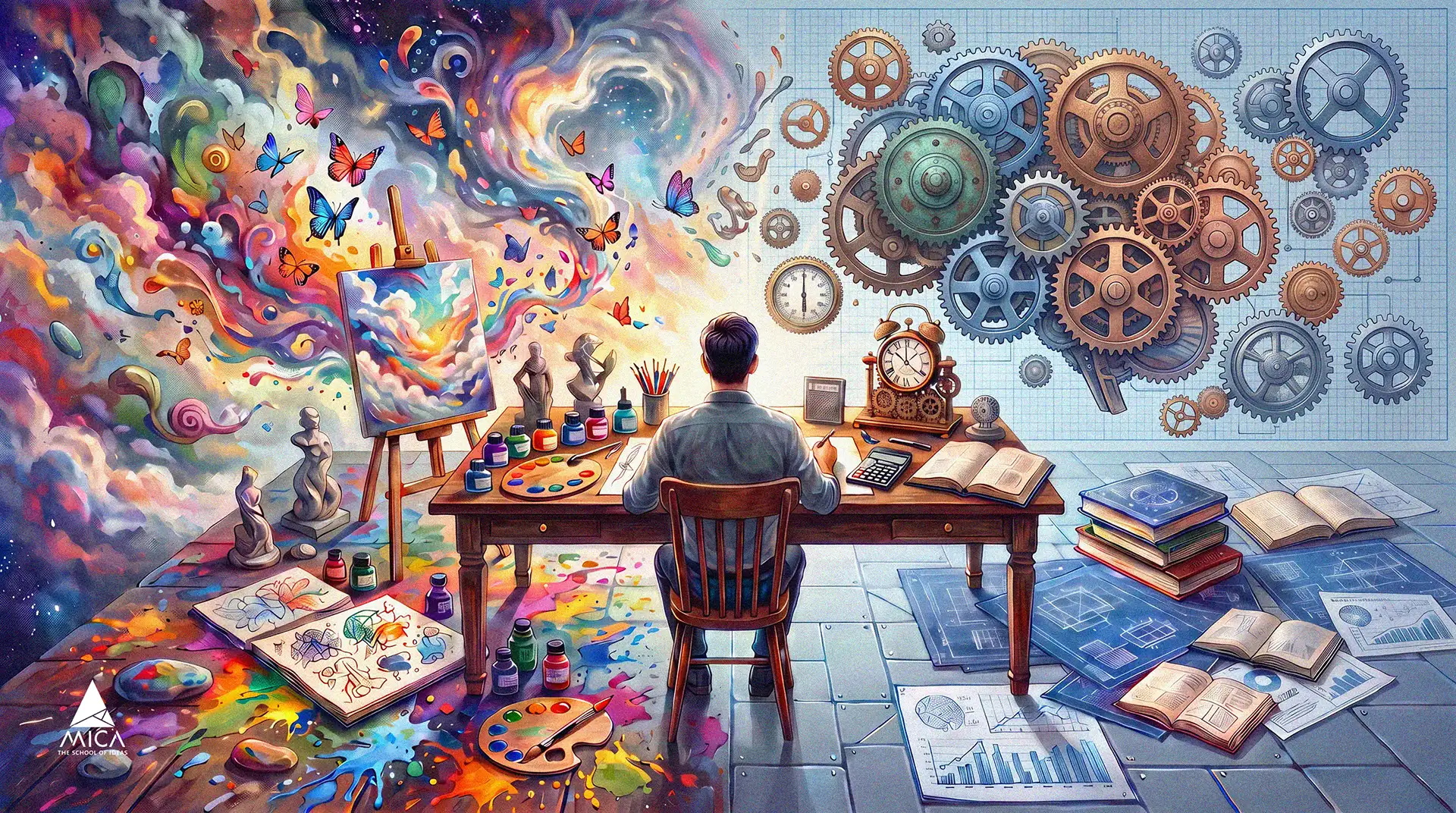
For MICA, this is most opportune moment because MICAns flourish in ambiguity. Every touch point here offers a reason for the students to practice creative solutioning than mastering frameworks and models to optimise and maximise. MICA has always operated at an intersection of creative and analytical learning, where students from diverse academic and geographic backgrounds interact. And in such an environment imagination finds home and creativity thrives. For MICA, this has come. The Imagination Age that does not reward those who know the most. It rewards those who can imagine what has not yet been built.